Ambient AI Is Transforming EHRs: How MEDENT Accelerated Growth with Suki
October 21, 2025
How do you balance innovation with impact? At Suki, our mission is to lift the administrative burden from clinicians by building healthcare technology that is invisible and assistive, so providers can focus on their patients. The result? Suki improves the clinician experience while also giving our customers a strong ROI.
Healthcare leaders have the same goals in mind when selecting an AI partner. They want to see better clinician satisfaction and decreased burnout, balanced with measurable business results. The key to striking this delicate balance is embedding AI capabilities directly into existing workflows, instead of bogging clinicians down with new tools or systems.
That’s why MEDENT partnered with Suki to embed ambient clinical documentation directly into their EHR. The results demonstrate how Suki Platform (https://www.suki.ai/suki-platform/) enables partners (https://www.suki.ai/for-partners/) to bring AI capabilities to market quickly, seamlessly, and at enterprise scale.
Recently, Megan Chapman, Director of Marketing and Communications at MEDENT, sat down with Matt Del Favero, Project Manager at MEDENT, and Heather Miller, VP of Partnerships at Suki, to discuss their journey, the impact on clinicians, and what’s ahead.
Follow the link to listen to the full podcast episode on Spotify. Or keep reading for our key takeaways from this informative and insightful conversation.
Why MEDENT Chose to Embed Suki
When MEDENT began exploring AI solutions, the team knew exactly what they needed from a partner. First, the integration had to be seamless. They wanted technology that could embed directly into their EHR without placing an additional burden on their developers or disrupting established workflows. Second, they needed credibility. With so many new AI entrants appearing almost overnight, MEDENT was determined to work with a partner that had both a proven track record in healthcare and the ability to scale with their growing user base.
Suki checked both boxes. As Del Favero explained, “The thing that attracted us to Suki was that they seemed much more advanced than the other ones. They had integration built in and were flexible in working with us to meet the needs of our client base.” The result was exactly what MEDENT had hoped for: a low-effort, high-value integration that quickly delivered tangible benefits for clinicians.
Suki’s Mission: Invisible, Assistive AI
Miller emphasized that Suki’s long-standing vision has been to make healthcare technology invisible and assistive so clinicians can focus on patients.
“We’ve been building AI for healthcare since 2017, long before AI became a buzzword. Our platform lets clinicians document seamlessly in their EHR, without extra steps,” said Miller.
For MEDENT users, that means a native AI experience. A single click launches Suki AI, which ambiently listens to the visit and generates notes directly in their workflow. No toggling between systems.
Integration Features that Stand Out
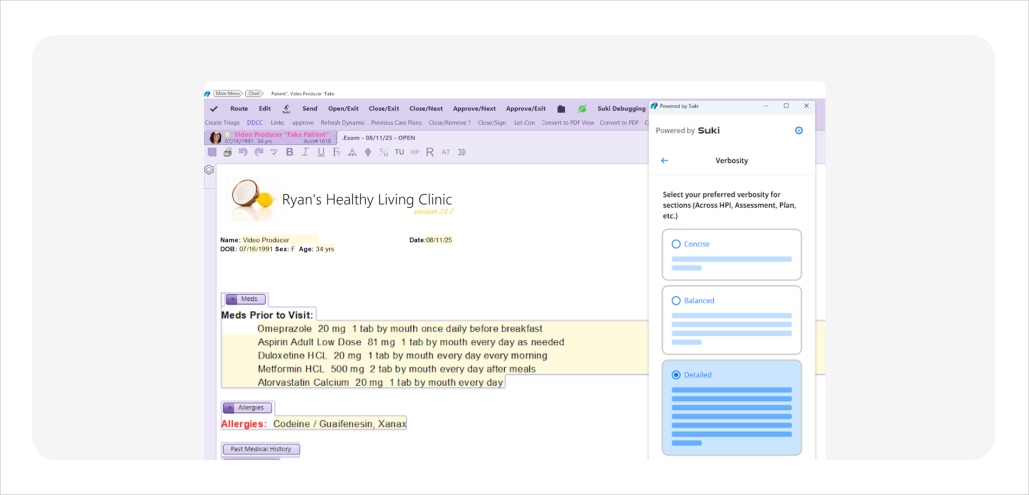
The MEDENT–Suki integration combines a set of capabilities designed to build clinician trust and ensure adoption at scale. The Personalization feature allows providers to tailor notes to their preferred style, whether concise bulleted lists or detailed narratives, cutting down on editing and making the documentation feel natural.
Multilingual support has been another key benefit. With over eighty languages supported, patients and families can speak in the language most comfortable for them, while notes are consistently translated back into English for the EHR.
Transparency is delivered through evidence linking, where each line of a note ties back to the transcript of the visit. This strengthens accuracy and trust, and is further supported by the use of LOINC and diagnosis codes, which help organize notes and improve interoperability.
The system also adapts to specialty context, ensuring that notes reflect the unique language and scope of different clinical fields, such as psychiatry versus orthopedics. Finally, an in-app rating system allows clinicians to provide immediate feedback on note quality, helping Suki continuously learn and improve.
Beyond Documentation: Expanding the Platform
While documentation is the foundation, the MEDENT partnership shows how Suki is extending into broader clinical workflows. One upcoming feature is order staging, which enables prescription orders to be generated directly from ambient sessions and staged in MEDENT for review and signature.
Other enhancements focus on daily efficiency. For instance, nurses and providers can run multiple ambient sessions for the same patient during a visit, and the notes merge into a single record, reducing duplication, while real-time visual cues in Chart Central help clinicians work more efficiently and avoid redundancy. Together, these developments demonstrate how Suki and MEDENT are evolving their partnership beyond documentation into medication orders and enhanced workflow automation.
Why This Matters for EHRs and Healthtech Companies
The MEDENT–Suki story illustrates what’s possible when AI is embedded directly into existing healthcare workflows. By going live with limited development effort, MEDENT was able to accelerate its roadmap with a trusted end-to-end AI partner and quickly deliver a differentiated experience for its users. Ambient AI is increasingly becoming an expectation, and MEDENT’s approach shows that it can be delivered in a way that is seamless and intuitive.
The integration also highlights enterprise-level quality. Features such as evidence linking, personalization, coding, and specialty awareness ensure documentation meets clinical standards, while clinicians experience the technology as invisible and assistive. By reducing workflow burden, the platform drives satisfaction and loyalty among clinician users. And because the AI is embedded directly into the EHR, adoption is high, strengthening both clinician engagement and long-term customer retention.
Shared Vision for the Future
At the heart of the partnership is a shared goal of reducing administrative burden. As Miller explains, “Our shared vision with MEDENT is to continuously reduce administrative burden while empowering clinicians to do what they do best — care for patients.”
For MEDENT, that commitment translates into happier clinicians and stronger client relationships. For Suki, it reinforces the role of the platform as a foundation for integrations that evolve with healthcare organizations’ needs. Together, both teams are shaping a future where ambient AI is not an add-on, but a natural part of how care is documented and delivered.
Follow the link to listen to the full podcast episode on Spotify or YouTube.