The Rise of Ambient AI: A Gamechanger for Primary Care and Physician Burnout
July 10, 2025
Amid increasing levels of burnout, dissatisfaction, and administrative overload in primary care, a new class of technology is reshaping the clinical landscape: Ambient AI Assistants. In a groundbreaking, independently conducted study by Phyx Primary Care, this category of AI technology, specifically Suki Assistant, demonstrated not only measurable improvements in time savings and documentation quality but also a profound impact on physician wellbeing.
This isn’t just a tech story; it’s a turning point for the healthcare industry. Keep reading for six key takeaways from the latest Phyx Primary Care Report, “Ambient AI Assistant Transforms the Primary Care Experience”.
1. Burnout Relief, Not Just Workflow Efficiency
Historically, technology in healthcare has added complexity, not simplicity. EHRs were meant to streamline care, but typing up patient notes can be time-consuming for busy clinicians. In contrast, the results from the Phyx Innovation Lab present a compelling counter-narrative: Ambient AI reduces rather than adds to the burden.
Physician burnout decreased by 60%, and satisfaction jumped by 81% after the introduction of the Suki AI Assistant. In fact, for those already reporting burnout, their burnout scores dropped from a “concerning” 3.4 to a manageable 2.4 on a 5-point scale.
The message is clear: Ambient AI Assistants don’t just save doctors time, they significantly reduce doctors’ administrative burden and cognitive load.
2. Documentation as a Byproduct, Not a Burden
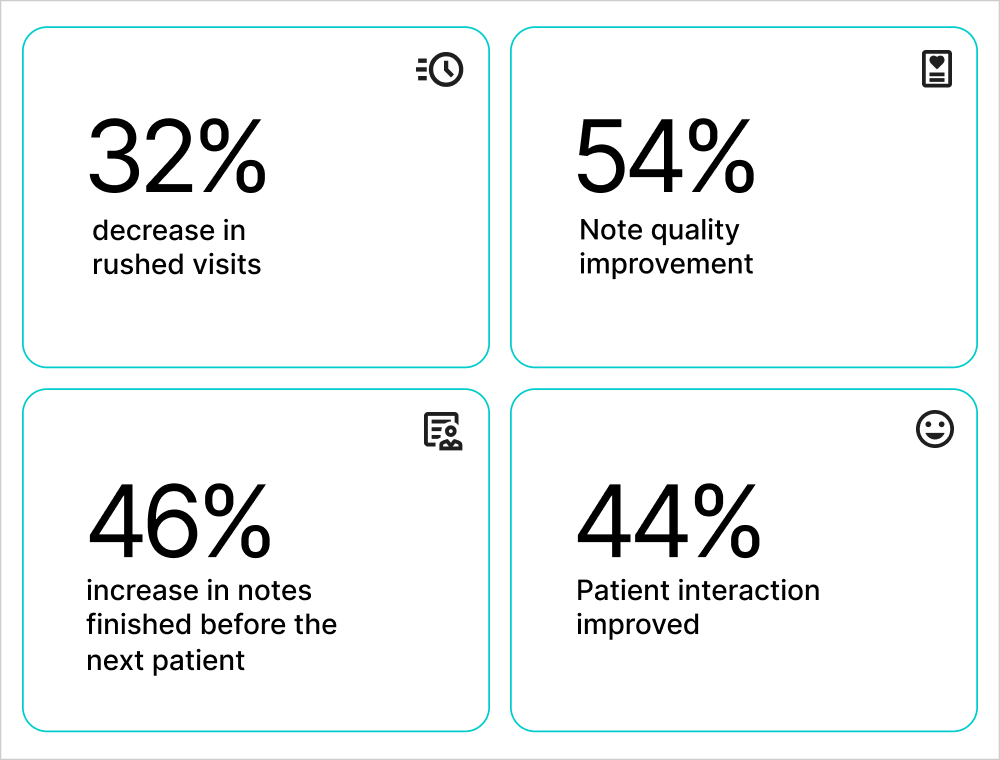
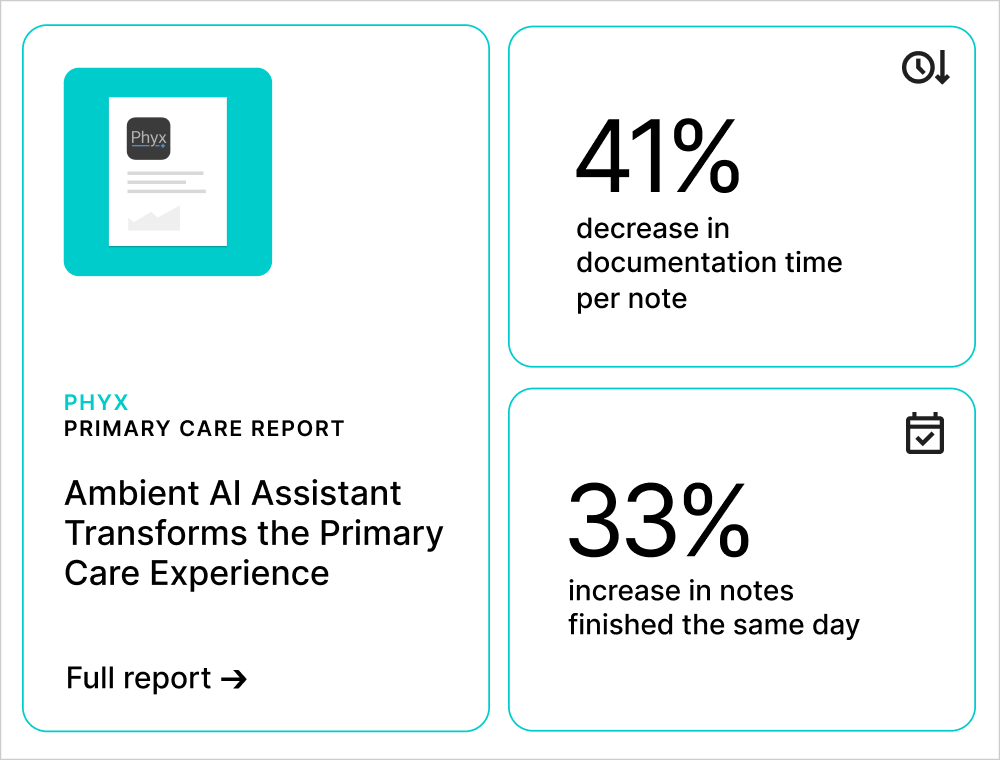
With the rise of the AI assistant and its profound impact on documentation, healthcare technology is finally living up to its promise. Physicians reported a 41% reduction in documentation time per note, a 33% increase in same-day completion, and a 46% boost in getting notes done before the next patient.
Why does this matter? Because documentation has historically been a cognitive and temporal burden, pulling physicians away from patient care and into clerical labor. As one respondent put it: “The note now writes itself while I focus on my patient. It’s a completely different experience.”
The Ambient AI model listens, understands, and drafts clinical notes from natural patient-physician dialogue, allowing documentation to flow organically from the visit, instead of interrupting it.
Click here to read the full report from Phyx Primary Care.
3. After-Hours Time Is Finally Shrinking
One of the most tangible outcomes from the study: physicians gained back nearly 48 minutes a day of after-hours work. That’s nearly 4 hours per week—time that physicians are no longer spending tethered to screens at home.
More than just a metric, this shift points to a long-awaited rebalancing between professional and personal life. Satisfaction with after-hours time increased 46%, signaling a deeper emotional and psychological shift.
In the words of one physician: “I no longer dread the end of the day. I have my evenings back.”
4. Better Notes, Better Coding, Better Reimbursement
A key differentiator with Ambient AI Assistants: the quality of documentation didn’t just remain intact, it improved. Note quality was reported to have improved by 54%, with physicians citing better structure, completeness, and clinical richness.
This matters not only for compliance and care continuity but also for revenue integrity. Richer documentation leads to more accurate coding and better reimbursement, critical for organizations struggling under tight margins and fee-for-service pressure.
By offloading the clerical and cognitive load, physicians can focus on listening, explaining, and treating, making documentation a valuable artifact of care, not a task separate from it.
5. AI Clinical Assistants: A New Category Emerges
Not all Ambient AI tools are created equal. The Phyx report draws a clear distinction between basic “Ambient Scribes” and more advanced “AI Clinical Assistants.” The latter, exemplified by Suki, represents a platform-based approach with strong integrations in existing tech solutions, like Zoom for telehealth, as well as an ambitious roadmap for the future, such as medication reconciliation, inbox management, expanded support for billing codes, and more.
These assistants aren’t just smart, they’re evolving. Backed by major advances in voice and generative AI, they’re equipped to scale across specialties and workflows, supporting the full spectrum of physician tasks.
The real innovation isn’t transcription. It’s assistance. It’s moving from clerical automation to clinical enablement.
6. The Human ROI: Autonomy, Mastery, and Purpose
The most profound insight from the Phyx report may not be numerical. It’s emotional. Physicians described the assistant as “a gamechanger”—a rare term in an industry often let down by overhyped solutions.
Why? Because this is about more than time savings. It’s about restoring what drew clinicians to medicine in the first place: connection, presence, mastery, and a sense of purpose.
The report concludes with a hypothesis: the outsized gains in satisfaction may not be solely due to time saved, but to the overdue arrival of hope.
A New Era for Primary Care
Primary care has long struggled under the weight of volume-based reimbursement and technology that prioritized data over people. Ambient AI Assistants mark a turning point—a shift toward tools that actually serve the clinician.
For healthcare leaders, the takeaway is urgent and clear: AI Clinical Assistants aren’t a future state. They’re a current imperative.
As Phyx puts it, “The richer the patient interaction, the richer the clinical note—and the better the primary care experience.”
This is how we fix primary care. Not by asking physicians to do more, but by giving them technology that finally lets them do less, better.
Click here to read the full report from Phyx Primary Care.