Ambient Listening in Healthcare: From Burnout to Bandwidth
August 25, 2026
Every clinician knows the ritual. The last patient leaves, the clinic goes quiet, and the second shift begins: hours of charting to catch up on, a mountain of administrative work that follows them home every night.
This after-hours "pajama time" is more than an inconvenience. Documentation burden is one of the most consistent drivers of clinician burnout, and it steals something harder to measure: presence in the exam room.
For two decades, the answer was to train clinicians to work around technology. Ambient listening flips that. The technology adapts to the clinical encounter, and the evidence behind it is no longer anecdotal. Peer-reviewed studies across thousands of clinicians now show measurable drops in burnout, hours reclaimed, and better patient interactions.
Here's what ambient listening is, how it works in medicine, and what it means for clinicians, patients, and the health systems that support them.
What is ambient listening?
Ambient listening is context-aware technology that passively captures voice and other cues in an environment, then acts on what it hears. No wake words. No dictation. No commands.
That distinction matters. Earlier voice tools required clinicians to stop, speak in structured phrases, and correct the output. Ambient listening captures the natural conversation continuously, without changing how anyone talks.
Under the hood, three technologies work together:
- Speech recognition converts spoken words into text with high accuracy
- Natural language processing (NLP) interprets meaning, context, and intent
- Machine learning improves output over time by learning from patterns and corrections
You already live with ambient technology, like smart speakers that hear a request across the room, and cars that respond to conversational commands. Healthcare is simply the highest-stakes place to apply it, because the conversation being captured is the clinical encounter itself.
Ambient listening in the clinical context
In an exam room, ambient listening works like this: a smartphone or in-room microphone captures the visit, the system separates who's speaking, and AI extracts the clinical substance, like symptoms, medications, diagnoses, and care plans. Within moments, a structured draft note appears.
The clinician's role shifts from author to editor — reviewing and signing a note instead of writing one from scratch.
That draft syncs directly into the EHR. With deep EHR integrations across Epic, Oracle Health, athenahealth, MEDITECH, and others, the note lands where clinicians already work — no copy-paste, no separate portal.
How does it compare to a human scribe or dictation?
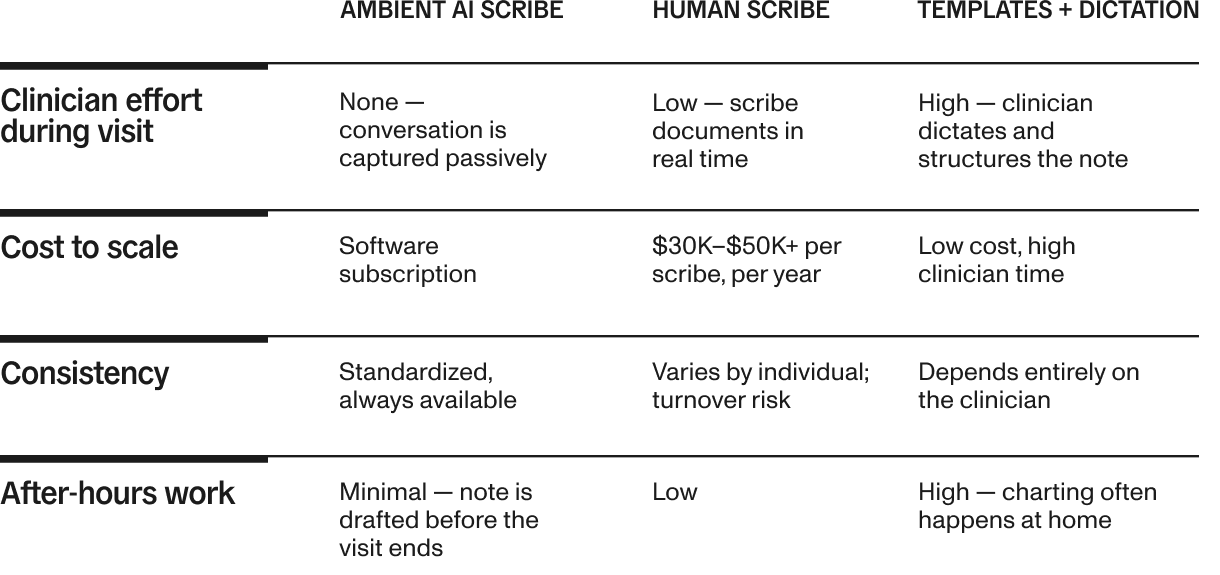
For health system leaders, the enterprise picture matters as much as the exam room. Modern ambient platforms offer flexible deployment models, broad EHR interoperability, and review-in-the-loop design; the clinician always verifies before the note is signed.
That last point deserves honesty. Ambient AI can miss details or, rarely, generate content that wasn't said. Responsible platforms treat clinician review as a mandate, not a formality — and we'll cover governance, privacy, and security later in this post.
Impact on clinicians: reduced stress, lower burnout rates
Start with the baseline: documentation burden and after-hours charting are among the strongest predictors of clinician burnout. So if ambient listening works, burnout metrics should move.
They do.
- Burnout fell 21.2% at Mass General Brigham, and Emory Healthcare clinicians reported a 30.7% improvement in documentation-related wellbeing, in a JAMA Network Open study spanning more than 1,400 clinicians (Mass General Brigham, Emory Healthcare)
- Burnout rates dropped from 51.9% to 38.8% in a multi-system study, alongside lower cognitive load and less after-hours work (PubMed, PMC)
- Kaiser's Permanente Medical Group saved roughly 15,791 hours of documentation time — about 1,794 workdays — and 82% of physicians reported better work satisfaction (NEJM Catalyst, Permanente)
Adoption tells the same story. Mass General Brigham started with an 18-physician pilot in 2023. By 2025, more than 3,000 providers were using ambient documentation (Mass General Brigham). Pilots that fail don't scale 165x.
The numbers matter, but so does what clinicians say behind them. Three themes come up again and again:
- Restored joy in the practice of medicine — the reason most clinicians chose this work
- More presence with patients, instead of divided attention between person and screen
- Less cognitive load — the mental tax of holding a note in your head all day, gone
From clinician relief to improved patient outcomes
Here's the bridge that often gets missed: the note itself doesn't improve care. A less-burdened, fully present clinician does.
When documentation stops competing for attention, the visit changes. A 2026 JMIR Medical Informatics study measured exactly that: clinician eye contact and presence increased 10.6% with ambient documentation, with eight of nine clinicians improving — gains ranging from 4.2% to 35.8% (JMIR Medical Informatics).
The same study found clinicians spent about 15% less time on documentation — time redirected to the patient in front of them (JMIR Medical Informatics).
Patients notice the difference between a clinician typing at a screen and a clinician looking them in the eye.
For patients, that shift is felt immediately: attentive engagement instead of a divided-attention visit. The downstream effects, like stronger communication, more trust, and better follow-through on care plans, are where the evidence is still emerging. Early signals are promising, but health systems should treat those quality links as developing rather than established.
For clinicians, the equation is simpler. Presence is the product.
How health systems benefit
For CIOs, CMIOs, and CFOs, ambient listening isn't a wellness perk. It's an infrastructure decision with measurable returns.
- Capacity without headcount. Reclaimed documentation hours convert directly into clinical capacity. Kaiser's 1,794 recovered workdays represent visits, not overtime.
- Retention as ROI. Replacing a single physician can cost hundreds of thousands of dollars. If ambient documentation reduces burnout — the leading driver of turnover — it functions as a retention lever.
- A defensible business case. Time saved, satisfaction gains, retention impact, and improved coding accuracy all contribute to ROI. Each is contingent on two things: documentation accuracy and real clinician adoption.
- Scalability and equity. Enterprise buyers should ask how a platform performs across specialties, languages, accents, and care settings — not just in primary care pilots.
The strongest signal in the market is that leading systems are past the pilot phase. The question has shifted from "does this work?" to "how fast can we scale it responsibly?"
Risks and governance
No serious evaluation skips this section, and neither should vendors.
Accuracy and the human in the loop. Ambient AI drafts; clinicians decide. Every note requires clinician review before signing, and platforms should make that review fast, not burdensome.
Privacy, consent, and security. Clinical conversations are among the most sensitive data that exists. Health systems should require clear patient consent workflows, encryption in transit and at rest, and a documented compliance posture (HIPAA at minimum, SOC 2 as table stakes).
Change management. Technology fails when trust does. Successful deployments invest in training, workflow integration, and clinician champions — not just licenses.
Vendor criteria. Evaluate on four dimensions: depth of EHR integration, security architecture, published evidence base, and quality of implementation support.
Handled well, governance isn't a brake on ambient listening. It's what makes enterprise-scale adoption possible.
AI that’s putting an end to endless admin
The chain is now visible end to end: ambient capture → clinician relief → patient presence → system resilience. Each link is supported by peer-reviewed evidence, not vendor promises.
For health system leaders, the question is no longer whether to adopt ambient listening. It's how to adopt it responsibly, at scale, with a partner built for clinical-grade accuracy and enterprise-grade integration.
Ready to see what ambient listening can do for your health system? Contact us to learn how Suki makes ambient intelligence foundational to your clinical infrastructure.