Healthcare’s next chapter starts here
Meet Suki OS
Connect the dots.
Close the gaps.
Truly empowering presence at the heart of care requires a more human experience and a more intelligent system. One that doesn’t just improve your workflow, but actually links it together, takes action, and keeps things moving — so you can turn your to-dos into “done.”
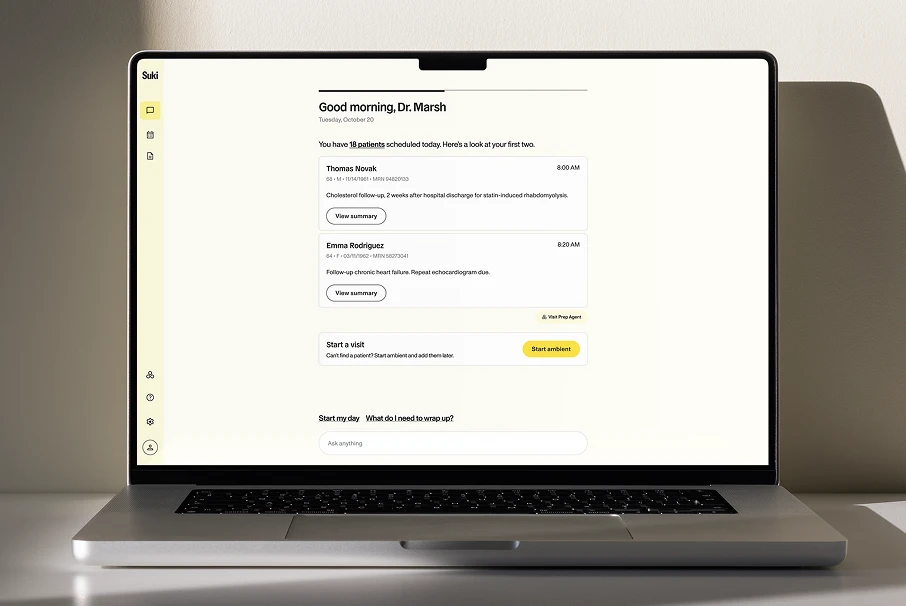
Suki OS is the agentic operating system that unifies ambient capabilities, world-class partners, and next-gen agents in a single integrated interface. It connects your systems, organizes your tasks, surfaces the information you need at the right time, and places an action layer atop it all that reimagines the clinical workflow from end to end.
Insight coordinated into agentic action
Suki OS connects clinical intelligence with agents that can execute complex workflows to move care forward and support clinical decision-making.
Sports injury.
Right ankle pain.
- Analyzed patient’s record
- Searched UpToDate for guidance
- Reviewed evidence-based recommendations
- Generated summary with citations
Assumptions:
You’re asking about a 62-year-old male patient, type 2 diabetes, BMI 32, no known CVD, on lisinopril and empagliflozin, with A1c of 7.4.
For a patient on maximally tolerated lisinopril and empagliflozin with UACR 30–99 mg/g with eGFR >25 and potassium <4.8 mEq/L, the guideline-directed next step is to add finerenone for kidney and cardiovascular protection and a GLP-1 RA (semaglutide preferred) for glycemia and weight. [1], [4], [5], [6]…
Built to assist, not replace
Ask questions about patient charts, medication interactions, your daily schedule, outstanding approvals and tasks, or anything else you need. Suki OS will surface accurate answers enriched with specialized partner intelligence and insights.

Assumptions:
You are asking about a 62-year-old male patient, Type 2 diabetes, BMI 34, no known CVD, on lisinopril and empagliflozin, with A1c of 7.4.
For a patient on maximally tolerated lisinopril and empagliflozin with UACR 30–99 mg/g with eGFR >25 and potassium <4.8 mEq/L, the guideline-directed next step is to add finerenone for kidney and cardiovascular protection and add a GLP-1 RA (semaglutide preferred) for glycemia and weight. [1], [4], [5], [6]...
Versatile by design
Suki OS is engineered to integrate, not isolate, so you can keep your existing processes in place and build the workflows that suit your needs.



Here for you 24/7
From prepping your schedule to offering hyper-specific coding recommendations, Suki OS shoulders the administrative load in the background so you can keep patients in the foreground.





Fusion, not fragmentation
All your workflows, finally working together. Suki OS connects schedules, patient context, orders, referrals, prior auth, coding, and more.




The trusted Partner Ecosystem
The Suki Partner Ecosystem brings together specialized intelligence and AI capabilities from across healthcare, helping organizations get more value from their existing technologies. The ecosystem offers two integration paths:
Suki Platform Partners: Enables healthcare technology companies to embed Suki's AI into their products. Suki already powers AI capabilities for more than 30 healthtech companies.
Suki Insights Partners: Integrates partners' intelligence with Suki's patient context to deliver relevant insights at the point of care.
“Suki OS is a step toward a future where technology doesn't just support healthcare. It helps transform what's possible.”
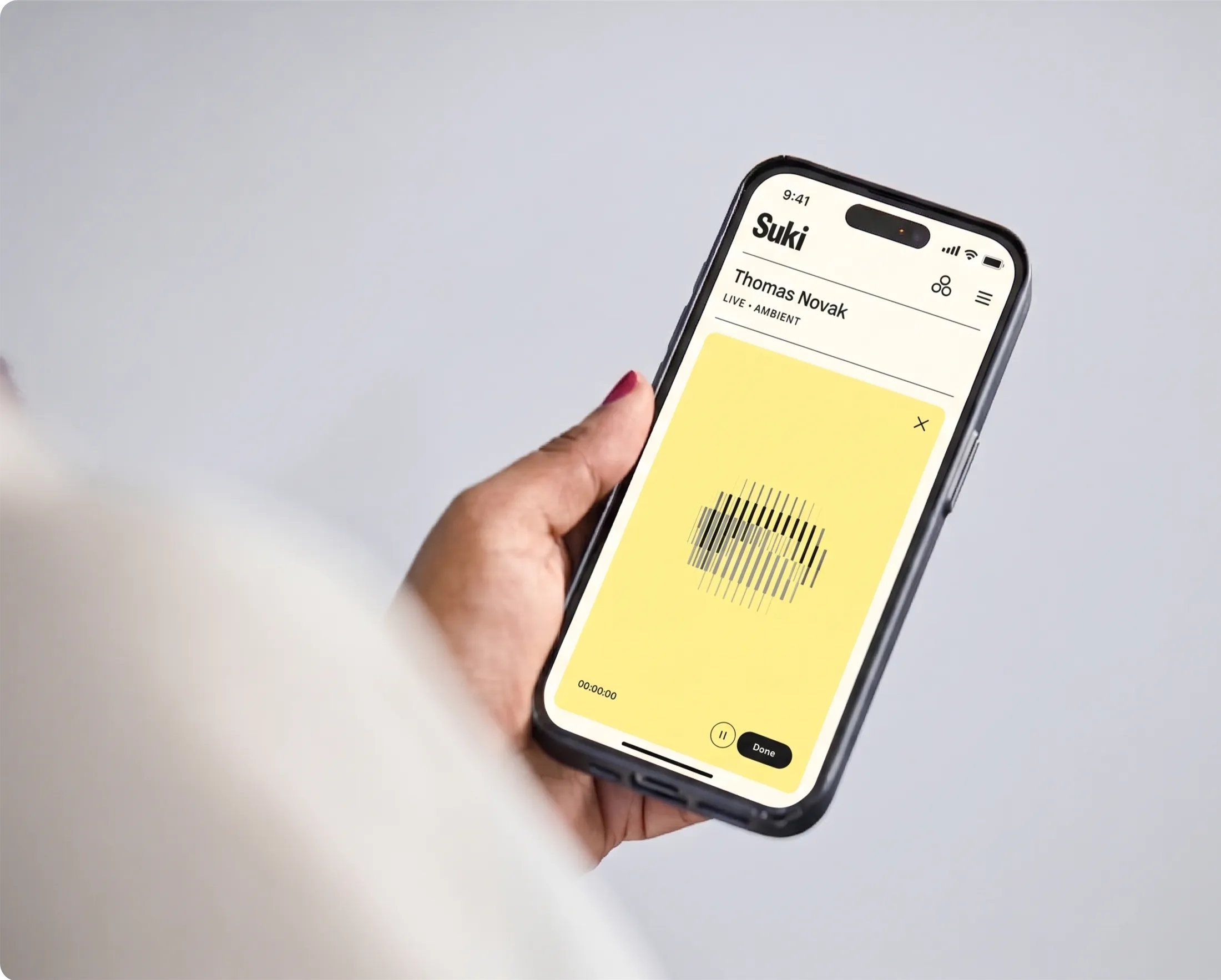
Be among the first to experience Suki OS.
Get on the priority interest list for early updates, exclusive previews, and opportunities to explore Suki OS as new capabilities become available.
Frequently asked questions
Can I keep using my existing Suki products and workflows with Suki OS?
Absolutely. Suki OS builds on the Ambient Clinical Intelligence technology that powers your existing Suki experience. Your current products and workflows, including Suki for Clinicians and dictation, will continue to work as they do today. As Suki OS evolves, it will introduce new capabilities, including agents designed to coordinate and execute complex workflows, while the Suki Guarantee provides a performance-based commitment to measurable outcomes. No immediate changes or migration are required.
Does using Suki OS require me to replace my existing systems and partners?
No. Suki OS is built to work with the systems and partners you already use, not replace them. It will integrate with your EHR (Epic, Oracle Health, MEDITECH, athenahealth) and connect to partner data and tools, with Suki's forward-deployed engineers handling the integration work. Your current Suki products keep running in your existing workflow, and you can add Suki OS capabilities where they help.
When will Suki OS be available?
Suki OS builds on Suki's proven Ambient Clinical Intelligence technology, which is available today and used by more than 450 healthcare organizations. New Suki OS capabilities, including agents, are currently in development and will be introduced in phases. Healthcare organizations interested in exploring Suki OS can connect with our team to learn more about upcoming capabilities and stay informed as they become available.
How can healthtech partners build with Suki OS?
Suki OS expands the possibilities for healthtech companies to build AI-powered healthcare experiences. Today, more than 30 partners leverage Suki's Ambient Clinical Intelligence technology, SDKs, and APIs to embed AI capabilities directly into their products and workflows. As Suki OS evolves, partners will have opportunities to build on Suki's clinical intelligence and emerging agentic capabilities, enabling more connected experiences across the care journey. New capabilities will be introduced in phases as we expand the Suki partner ecosystem.
How can I be among the first to experience Suki OS?
While existing capabilities like ambient documentation and dictation are available today, new agents, including Prior Authorization and Clinical Documentation Improvement (CDI), are in development and will be introduced in phases. We're working with select healthcare organizations to help shape these new capabilities. Connect with our team to express your interest and explore opportunities to be among the first to experience Suki OS.
How does Suki OS ensure security and clinician oversight?
Suki OS is being built with security, governance, and clinician oversight at its core. As AI agents take on more complex clinical and administrative tasks, Suki OS is designed to give healthcare organizations control over how agents operate, with appropriate safeguards and human oversight. The goal is to automate more work while keeping clinicians in control and maintaining the security and governance standards healthcare organizations expect.